

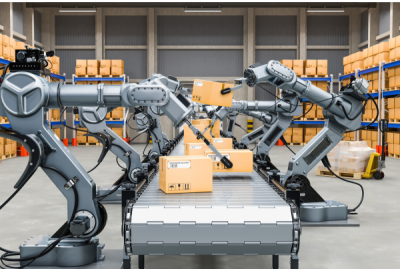
Transforming Warehouse Efficiency: The Impact of Floor Conditions on AMR and AGV Performance.
The implementation of Autonomous Mobile Robots (AMRs) or Automated Guided Vehicles (AGVs) has the potential to completely redefine the efficiency of your material handling operations. With a wide range of options available from various manufacturers and integrators, you can fine-tune this technology to meet your specific application and operational goals. However, the efficiency and return on investment (ROI) of even the most advanced warehouse automation systems can be significantly impacted by the surface on which the robots operate. Specifically, the condition of your facility floor plays a pivotal role in the performance of your warehouse automation system.
To gain genuine feedback from the field and to better understand the flooring challenges you may experience as a facility manager or integrator when implementing AMRs and AGVs, we spoke with Jonathan Osborne, Senior Territory Manager of QuestMark. He has extensive experience in preparing commercial floors for AMR and AGV implementation across various facilities in the United States.
Our first question was, of course, what are the core requirements for optimal AMR performance?
Jonathan: Each manufacturer has different specifications. Everything depends on the system's function and the operational needs. In some cases, we are discussing purely transferring items from one side of a warehouse to another. In other instances, interaction with conveyors is expected, such as picking up items from the belt and moving them to a shipping point or placing them at another drop-off point. Sometimes, lifting or pushing tasks are required.
Systems can become quite complex, but ideally, this complexity should be self-sustainable. When implementing robotics and automation to improve operational efficiency, the goal is to set it up and forget it. Unfortunately, if your floor condition interferes with the robots' functions, the efficiency goals that justify such a significant investment may be compromised.
For example, in one of the recent facilities we worked in, the only requirement was a flat floor with no damage that could obstruct the robots as they moved back and forth. If the robots encounter a significant crack in their path, they will stop to analyze the obstacle and recalibrate. In some cases, a technician may need to come and reset them manually. In other instances, the system might not classify a crack as a significant obstacle allowing them to run over it. This can cause the load to rattle, which in turn may trigger a complete stop.
In that facility, we addressed problems like joints, cracks and slab deviations. However, slight variations in the floor's pitch, as long as they were within tolerance levels, were not critical due to the nature of the robots' function and the loads they carried.
But on another recent site, where robots lifted items 4 to 6 feet in the air and placed them on racks, the flatness of the floor became crucial. In this scenario, balancing the load was essential to prevent any tilting in one direction or another.
Overall, the machine's function defines the specifications and precise needs for the environment in which it operates.
Q: It seems that joints, which are an important part of concrete flooring, can be problematic for warehouse automation. How do you usually address this issue?
Jonathan: The approach we take depends on the condition of the joints and the requirements of the AMR/AGV system. If the joints are in good condition but starting to crown or create a bump, we can fill them with a flexible joint filler like polyurea. This allows for natural slab movement, which is crucial for concrete floors. For more severe issues, such as uneven slabs, we may need to grind down specific areas to ensure a smooth transition between levels. For extensive joint damage, a more comprehensive restoration process, such as joint reconstruction, will be necessary.
Q: What about Electrstatic Dissipative (ESD) flooring?
Jonathan: Definitely an important aspect to consider. Many industrial applications require ESD floor systems, while others may actually need conductive flooring. We're mostly seeing a demand for ESD flooring, but it's important to note that floor specifications can also be conductive, depending on the environment. For example, when protecting sensitive electronics from static electricity, a controlled, slow discharge via ESD is most appropriate. But in some unique situations where there is a high risk of static buildup and flammable materials are present, a faster discharge is necessary to prevent critical situations.
Q: Are floor demarcations something to consider when implementing AMRs or AGVs?
Jonathan: I have utilized line striping and other floor demarcations in various commercial facilities to help with the operation of AMRs, particularly in areas where they need to interact with products, such as at stops, pickup or drop-off zones. AGVs already follow predetermined paths established by the integrator, which typically include infrastructure components like magnetic tape, wires, paint or reflective markers. So, no floor demarcations are needed for the system itself. However, it's a great idea to use floor demarcations to communicate automation travel paths and safety hazard areas to your staff and visitors.
Q: Do robots damage floors? If so, what can be done about it?
Jonathan: Even if your facility did not have pre-existing floor damage before installing your AGV or AMR system, it is essential to closely monitor the floor's condition to ensure the efficiency of your automation investment. Due to frequent and repeated travel along the same paths, you may notice wear lines that can damage your existing floor system. Robots can create grooves in the concrete over time.
A common solution is to reinforce your floor using coatings or densifiers. However, regular inspections, maintenance and repairs are the most critical aspects. If your facility has planned shutdowns around the holidays or pauses operations during certain times of the day or night, this is an excellent opportunity for us to inspect and service your floors. Our technicians and crews are available to work overnight, on weekends and during holidays as needed to ensure your normal operations remain uninterrupted.
Q: Are there any do-it-yourself (DIY) flooring products that can help facility managers maintain the floors in AMR and AGV facilities between professional visits and inspections?
Jonathan: Absolutely! We supply mortars, crack fillers and cleaners that will help you maintain your floor according to your system's needs and specifications. You can reorder these products from your QuestMark representative or online. Additionally, we offer in-house training and demonstrations for all our products to ensure your maintenance team has everything they need to maximize the performance of your automation system through proper floor condition.
Q: Do you typically work with facilities or integrators?
Jonathan: We work with both integrators and end-users. It is very beneficial to bring us on board early in the process so we can assess the floor condition and determine what it will take to get the ideal state for your specific automation system. This will allow you to estimate robotics implementation and operation costs more accurately. I remember a time when a company had to halt its entire integration project due to the poor condition of its floor and serious issues that would prevent the automation system from functioning as intended.
Additionally, we can serve as a reliable go-to partner for integrators on future projects as we cover the entire United States with over 25 locations, delivering consistent results for any commercial facility from coast to coast.
High operational efficiency, speed and optimization of material handling procedures are compelling reasons to make a significant initial investment in Automated Mobile Robots (AMRs) or Automated Guided Vehicles (AGVs). However, inadequate floor conditions can negatively impact your bottom line due to physical obstacles for the robots, rattling of the carried loads, tilting, safety hazards, higher maintenance costs and potential damage to the robots themselves.
To ensure your warehouse automation system performs effectively and provides a return on investment, it is imperative to prepare your facility's floor to meet the specifications ideal for your type of robots and application. Whether you are considering installing a system in your building or you are an integrator looking for assistance with your next project, contact us today to ensure seamless execution and performance.


